Monday, August 13, 2012

At the Square VIII


First published on THE MANTLE
For E. Magdi & G. Maalouf
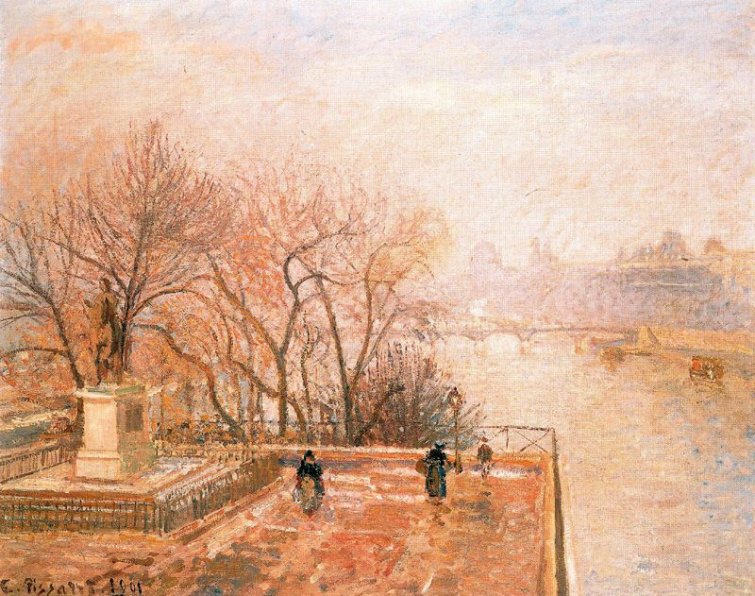
[Camille Pisarro, "The Louvre, Morning, Winter Sunshine", 1901]
"Well, no one has ever painted the landscape, man absent but entirely within the landscape"-Paul Cézanne
Passe-partout? Yes, the frame. I had never seen the frame in this painting. When I first saw it, in the years before the war, it seemed to me as if the painting was nothing but a little drawing, in blue, set against faded cerulean cardboard. "A phoenix of a book, written out of the ashes of another book, the novel is a tribute to bitterness and to tenacity - that of the bereft girl of the early 1600's who will, against all odds, become a renowned painter, that of a bereaved author who will write a novel that is surely more original than the one consumed in the fires of war. Loss had made the author free to enter the book, talking to herself and toArtemisia." Did you see the lake, Eman? No, I didn't see it myself. I think there were some young men in a boat. It's a difficult drawing I know, especially if you're focusing on the water, not wanting to see the faces; but if you don't want to draw the faces, you can begin by drawing the empty space around them. You can always imagine not that it is a void, but a still-life; remember the Flemish painters? It was Clara Peeters, I think. "But there was time; this was supposed to last a lifetime." Now the frame was almost bigger than the painting, so adorned, extravagant, baroque.
"How do people paint from memory? And from the memory of others?" That is a legitimate question Eman; my problem with still-life is that it seems as if there, the world is already redeemed and I don't want that. "Injustice is a wine that intoxicates both the judge and the victim. I have known the taste of that wine." I really wanted to be at the lake. It is a lesson, Saint Augustine would say: "Who will hold the heart, and fix it so that it may stand still for a little while and catch for a moment the splendor of eternity which stands still forever, and compare this with temporal moments that never stand still, and see that it is comparable... but that all this while in the eternal, nothing passes but the whole is present." This is the problem with memory, that is so corruptible, because you have access to all of your experience simultaneously; there are no blocks, no fragments. "But if nothing stands still, how do you paint?" I think you need some trust Eman, you need to believe that his essence can be touched, felt as carnal and the lines on the torso seen unsymmetrical, imperfect. "It is Artemisia who becomes a time traveler, a visitor, a phantom so real she can be measured even physically in the author’s consciousness."
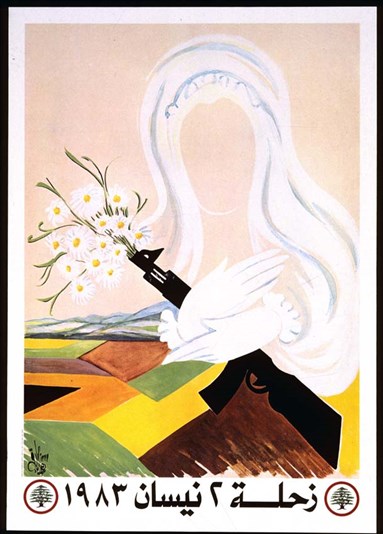
[Pierre Sadek, political poster, Battle of Zahlé, 1983]
Love is strange, Eman; it makes you at home by destroying the distance that the world demands for being an object, but yet it is the requirement to make oneself at home in it, with others as well. "It was a faceless love, without end or hope, enlightened, with fogs and snows, an immense river, boats with musicians and dances over the fresh grass". Things are very important to me, thingness, embodiment; but no matter how ensouled, objects do not love you back. "Then why do you want to find the icon? Had you wished it, you would know where to go, perhaps you wouldn't even need to go anywhere at all." Yes, Eman, you're right, nothing has changed. "We chase each other, Artemisia and I, and play to seize each other not without tricks, from the most material and obvious, to the most secretive. I abandon her after the war, during the first journey, from which I say, I may never come back. She pours ink on my paper from a vial and then we stare into each other." Perhaps. Perhaps he has come back. Perhaps a letter already arrived, all while we loitered about. You know, my whole life, I thought Gemayelwas a hero, that he had saved us, that we had won. We all had been lied to. "We're all displaced people after all", George said.
The rubble got into my shoes, all the way to Nottingham, and drowned from time to time at Ye Olde Trip to Jerusalem, that takes its name from the 12th centuryCrusades to the Holy Land. According to the legend, knights who answered the call of Richard I to join the crusades stopped off there for a pint on the way toJerusalem. We might have seen them, George, at Mousayliha, sitting in the pitch-dark. I couldn't remember one single thing and the Englishmen kindly handed out to me old newspapers with pictures from the siege of Beirut, replete with questions. "To write about the past is to write something like fantastic fiction. It is the strangeness of the past, rendered with piercing concreteness, that gives the effect of realism." I had to imagine everything again. "Anna Banti did not want to lose her manuscript in the battle of Florence in early August 1944. No writer could welcome such a destiny." Do you remember, Eman, when we read Joyce? "But this is the point. You die for your country. Suppose. Not that I wish it for you. But I say: Let my country die for me. Up to the present it has done so. I didn't want it to die. Damn death. Long live life".
"Non piangere. Don't cry. Who is talking? And where? It's the author, still in her nightgown (as in a dream, she writes), sitting on a gravel path in the Boboli Gardens -on the promontory on the south side of the Arno -sobbing, telling herself not to cry, and finally ceasing to cry, stunned by the even sharper realization of what was destroyed in the havoc of a few hours before." We've finally arrived, Eman. Beirut. George... How I had missed you, in the thousand years that passed; I'm so afraid, but I promise not to be afraid of that.
[Passages from Anna Banti, taken from "Artemisia: Romanzo", Mondadori, 1953. Passages from Susan Sontag, taken from "A Double Destiny: On Anna Banti's Artemisia", London Review of Books, 2003]

Monday, August 06, 2012

At the Square VII

First published on THE MANTLE

For E. Magdi & G. Maalouf
[Bayeux Tapestry, 1070]
"These men marvel at the star" -from the Bayeux Tapestry, recording the brilliant apparition of Halley's comet in 1066, during the days immediately following King Harold's coronation.
First he was beatified by Pope Jean Paul II on May 10th 1998 and then canonized on May 17th 2004. The young priest, a European, explained and then turned to Eman, chattering about the secrets of the icon, contemplation in color, transfiguration, embodiment, and the mystery of apocatastasis from the Acts of the Apostles: "Whom the heaven must receive until the times of restoration of all things, which God hath spoken by the mouth of all his holy prophets since the world began". The image is a memorial, read a line from St. John of Damascus, placed atop. What I imagined then: Will the Kingdom of God be restored? Everything will be like before? What was it like before? "What makes a genuine work of art and where is the secret of its perfection?" The young man asked her, in half ignorance, half arrogance. I stopped listening then and kept walking slowly and very close to the wall, almost embracing the calid stones with my limbs, staring into the half lit icons, maybe thinking that I would find him inside one of those woodcuts, like before.
Why was the saint in the desert? Maybe it was a reference to Saint Anthony the Great, credited with having founded Qozhaya, and the leader of the Desert Fathers. I had also been told that nature is never depicted in the icons, and we wondered about this together. Perhaps it was a recent rendition, because the golden glow was so fresh and not yet dead. Looking out the vaulted window without glass, the Kadisha Valley, spread between the two villages of the poet, without arms; our destination seemed far. "In that room there was a bed made from green pine, resembling in everything her own bed in Naples. She was lulled into believing that she was home and that this was the end of the journey." It was her first drawing outdoors, and she was sorry that she couldn't paint without characters, because it was like a drawing a void. The valley however, was heavily populated, by the Forest of the Cedars of God, that was so admired by the Israelites, who brought the cedars to Jerusalem to build their temples.
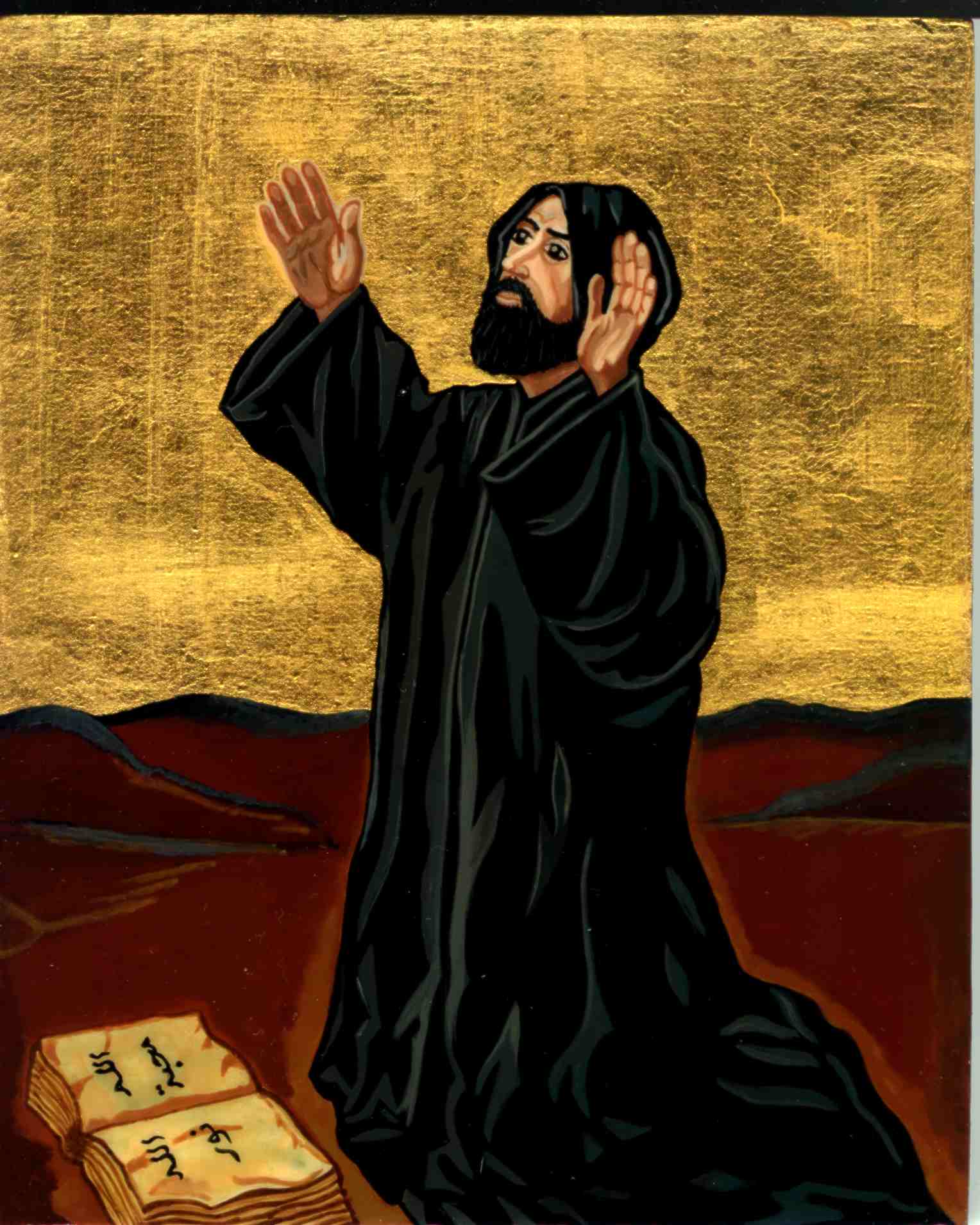
[Saint Nimatullah Kassab Al-Hardini, icon by Christine Habib El Daye]
"The Israelites haven't returned since then", complained one of the trees, standing there since the days of Solomon. Where else could I look for him? There are also the monasteries of Qannubin and Mar Sarkis, I thought. How could I have lost him? Lost him in this country?  "Under the ruins of my house, I have lost Artemisia, my companion of three centuries, as she laid down in the quiet, breathing, put to sleep by me in one hundred pages of writing." The priests had said that contemplating the icons would lead man straight to God, through the saints, and that made me believe that should I find the icon, the same icon Eman had done of him, in one of these monasteries, I could come to him. The night seized us, and she could no longer distinguish between the contours of the hills; in the distance, the smoke. "People that at four in the morning flee in droves, aghast, at the sight of the homeland turning into rubble; staring twice, to come to realize the terrors of a night in which the German landmines, one after another, shook the womb of the earth."
Some of the hermits lived in the vaulted caves, outside the forest, in Christian solitude; waiting. "It rains on the ruins over which I've already cried; on their contours the sounds had deadened their fright that after the first stroke of the shovel were now silenced forever. Artemisia's two graves, the real and the imaginary, are now the same, just inhaled dust." Can you see her, Eman? Can you see Artemisia? She tried so hard, but the light was too strong in the dark, and Artemisia never saw the light in the painting, only the perspective. "How could she not see the light?" Eman asked. And I didn't see it either. "Scorched a thousand times by the burns of the offense, a thousand times more does Artemisia fall back and catch her breath once again, to throw herself into the fire." Nothing in the direction of Bsharri, nothing in the direction of Tourza. "Almost nothing exists for me in this tired and faded white of dawn on a day of August. I lay on the soil, over the gravel paths in the Boboli Gardens, still in a nightgown, as if in dream." Saint Hardini, do you have friends?
"In Banti's account, what is central to Artemisia's life is not the rape; not the marriage with an obscure young man that her father imposed on her once the verdict was brought against the rapist; nor the four children (three of whom died) she bore her husband. It is her solitude, the inexorable result of her commitment to art." Eman, are you there? I don't think I can find him. George never told me the name of his village. 
[Artemisia Gentileschi, "Autoritratto come Allegoria della Pittura", 1638/39]
[Passages from Anna Banti, taken from "Artemisia: Romanzo", Mondadori, 1953. Passages from Susan Sontag, taken from "A Double Destiny: On Anna Banti's Artemisia", London Review of Books, 2003]
For E. Magdi & G. Maalouf
[Bayeux Tapestry, 1070]
"These men marvel at the star" -from the Bayeux Tapestry, recording the brilliant apparition of Halley's comet in 1066, during the days immediately following King Harold's coronation.
First he was beatified by Pope Jean Paul II on May 10th 1998 and then canonized on May 17th 2004. The young priest, a European, explained and then turned to Eman, chattering about the secrets of the icon, contemplation in color, transfiguration, embodiment, and the mystery of apocatastasis from the Acts of the Apostles: "Whom the heaven must receive until the times of restoration of all things, which God hath spoken by the mouth of all his holy prophets since the world began". The image is a memorial, read a line from St. John of Damascus, placed atop. What I imagined then: Will the Kingdom of God be restored? Everything will be like before? What was it like before? "What makes a genuine work of art and where is the secret of its perfection?" The young man asked her, in half ignorance, half arrogance. I stopped listening then and kept walking slowly and very close to the wall, almost embracing the calid stones with my limbs, staring into the half lit icons, maybe thinking that I would find him inside one of those woodcuts, like before.
Why was the saint in the desert? Maybe it was a reference to Saint Anthony the Great, credited with having founded Qozhaya, and the leader of the Desert Fathers. I had also been told that nature is never depicted in the icons, and we wondered about this together. Perhaps it was a recent rendition, because the golden glow was so fresh and not yet dead. Looking out the vaulted window without glass, the Kadisha Valley, spread between the two villages of the poet, without arms; our destination seemed far. "In that room there was a bed made from green pine, resembling in everything her own bed in Naples. She was lulled into believing that she was home and that this was the end of the journey." It was her first drawing outdoors, and she was sorry that she couldn't paint without characters, because it was like a drawing a void. The valley however, was heavily populated, by the Forest of the Cedars of God, that was so admired by the Israelites, who brought the cedars to Jerusalem to build their temples.
[Saint Nimatullah Kassab Al-Hardini, icon by Christine Habib El Daye]
"The Israelites haven't returned since then", complained one of the trees, standing there since the days of Solomon. Where else could I look for him? There are also the monasteries of Qannubin and Mar Sarkis, I thought. How could I have lost him? Lost him in this country?  "Under the ruins of my house, I have lost Artemisia, my companion of three centuries, as she laid down in the quiet, breathing, put to sleep by me in one hundred pages of writing." The priests had said that contemplating the icons would lead man straight to God, through the saints, and that made me believe that should I find the icon, the same icon Eman had done of him, in one of these monasteries, I could come to him. The night seized us, and she could no longer distinguish between the contours of the hills; in the distance, the smoke. "People that at four in the morning flee in droves, aghast, at the sight of the homeland turning into rubble; staring twice, to come to realize the terrors of a night in which the German landmines, one after another, shook the womb of the earth."
Some of the hermits lived in the vaulted caves, outside the forest, in Christian solitude; waiting. "It rains on the ruins over which I've already cried; on their contours the sounds had deadened their fright that after the first stroke of the shovel were now silenced forever. Artemisia's two graves, the real and the imaginary, are now the same, just inhaled dust." Can you see her, Eman? Can you see Artemisia? She tried so hard, but the light was too strong in the dark, and Artemisia never saw the light in the painting, only the perspective. "How could she not see the light?" Eman asked. And I didn't see it either. "Scorched a thousand times by the burns of the offense, a thousand times more does Artemisia fall back and catch her breath once again, to throw herself into the fire." Nothing in the direction of Bsharri, nothing in the direction of Tourza. "Almost nothing exists for me in this tired and faded white of dawn on a day of August. I lay on the soil, over the gravel paths in the Boboli Gardens, still in a nightgown, as if in dream." Saint Hardini, do you have friends?
"In Banti's account, what is central to Artemisia's life is not the rape; not the marriage with an obscure young man that her father imposed on her once the verdict was brought against the rapist; nor the four children (three of whom died) she bore her husband. It is her solitude, the inexorable result of her commitment to art." Eman, are you there? I don't think I can find him. George never told me the name of his village. 
[Artemisia Gentileschi, "Autoritratto come Allegoria della Pittura", 1638/39]
[Passages from Anna Banti, taken from "Artemisia: Romanzo", Mondadori, 1953. Passages from Susan Sontag, taken from "A Double Destiny: On Anna Banti's Artemisia", London Review of Books, 2003]For E. Magdi & G. Maalouf
[Bayeux Tapestry, 1070]
"These men marvel at the star" -from the Bayeux Tapestry, recording the brilliant apparition of Halley's Comet in 1066, during the days immediately following King Harold's coronation.
First he was beatified by Pope Jean Paul II on May 10th 1998 and then canonized on May 17th 2004. The young priest, a European, explained and then turned to Eman, chattering about the secrets of the icons, contemplation in color, transfiguration, embodiment, and the mystery of the apocatastasis from the Acts of the Apostles: "Whom the heaven must receive until the times of restoration of all things, which God hath spoken by the mouth of all his holy prophets since the world began". The image is a memorial, read a line from St. John of Damascus, placed atop. What I imagined then: Will the Kingdom of God be restored? Everything will be like before? What was it like before? "What makes a genuine work of art and where is the secret of its perfection?" The young man asked her, in half ignorance, half arrogance. I stopped listening then and kept walking slowly and very close to the wall, almost embracing the calid stones with my limbs, staring into the half lit icons, maybe thinking that I would find him inside one of the woodcuts, like before.
Why was the saint standing in the desert? Maybe it was a reference to Saint Anthony the Great, credited with having founded Qozhaya, and the leader of theDesert Fathers. I had also been told that nature is never depicted in the icons, and we wondered about this together. Perhaps it was a recent rendition, because the golden glow was so fresh and not yet dead. Looking out of the vaulted window without glass, the Kadisha Valley, spread between the two villages of the poet, without arms; our destination seemed far. "In that room there was a bed made from green pine, resembling in everything her own bed in Naples. She was lulled into believing that she was home and that this was the end of the journey." It was her first drawing outdoors, and she was sorry that she couldn't paint without characters, because it was like a drawing a void. The valley however, was peopled by the Forest of the Cedars of God that was so admired by the Israelites, who brought the cedars to Jerusalem to build their temples.
[Saint Nimatullah Kassab Al-Hardini, icon by Christine Habib El Daye]
"The Israelites haven't returned since then", complained one of the trees, standing there since those days. Where else could I look for him? There are also the monasteries of Qannubin and Mar Sarkis, I thought. How could I have lost him? Lost him in this country?  "Under the ruins of my house, I have lost Artemisia, my companion of three centuries, as she laid down in the quiet, breathing, put to sleep by me in one hundred pages of writing." The priests had said that contemplating the icons would lead man straight to God, through the saints, and that made me believe that should I find that icon, in one of these monasteries, I could come to him, to my lost friend. The night seized us, and she could no longer distinguish the composition of the hills; in the distance, the smoke. "People that at four in the morning flee in droves, aghast, at the sight of the homeland turning into rubble; staring twice, to come to realize the terrors of a night in which the German landmines, one after another, shook the womb of the earth."
Some of the hermits lived in the vaulted caves, outside the forest, in Christian solitude; waiting. "It rains on the ruins over which I've already cried; on their contours the sounds had deadened their fright that after the first stroke of the shovel were now silenced forever. Artemisia's two graves, the real and the imaginary, are now the same; just inhaled dust." Can you see her, Eman? Can you see Artemisia? She tried so hard, but the light was too strong in the interstices, and Artemisia never saw the light in the painting, only the perspective. "How could she not see the light?" Eman asked. And I didn't see it either. "Scorched a thousand times by the burns of the offense, a thousand times more does Artemisia fall back and catch her breath once again, to throw herself into the fire." Nothing in the direction of Bsharri, nothing in the direction of Tourza. "Almost nothing exists for me in this tired and faded white of dawn on a day of August. I lay on the soil, over the gravel paths in the Boboli Gardens, still in a nightgown, as if in a dream."Saint Hardini, do you have friends?
"In Banti's account, what is central to Artemisia's life is not the rape; not the marriage with an obscure young man that her father imposed on her once the verdict was brought against the rapist; nor the four children (three of whom died) she bore her husband. It is her solitude, the inexorable result of her commitment to her art." Eman, are you there? I don't think I can find him. George never told me the name of his village.
[Passages from Anna Banti, taken from "Artemisia: Romanzo", Mondadori, 1953. Passages from Susan Sontag, taken from "A Double Destiny: On Anna Banti's Artemisia", London Review of Books, 2003]
[Artemisia Gentileschi, "Autoritratto come Allegoria della Pittura", 1638/39]
Thursday, August 02, 2012

“You are Free”: Not in Lebanon


First published on BIKYAMASR

Early in June, with the beginning of the summer, as visitors prepared for holidays in the shores of the Mediterranean, a couple of LGBT-sites ran features on Lebanon, describing it as a melting pot of cultures from East and West, and praised its vibrant night life: “A visit to Lebanon reveals Roman treasures, natural wonders, outstanding food, cosmopolitan fun and a growing gay scene.”
While there is no doubt that the traditional view of Lebanon as the freest country in the Arab world is not without foundation, the truth is that the Lebanese have fought very hard for those freedoms and those freedoms remain increasingly threatened due to a combination of laissez-faire policy and tight censorship.
A Lebanese user commented to the article “Beirut and Lebanon: The gay paradise of the Arab world” with singular wit: “It is really a terrific place once you get past the routine power outs, the incredibly high prices, the harassment of gays in virtually any public venue, the criminal status of homosexuality, the corrupt, racist and homophobic police department, the sporadic tire-burnings and gun fights and the control that Islamic and Christian fundamentalists have over large parts of the country both in terms of territory and media. But yeah, other than that it’s terrific.” It’s true as well that there have been some improvements in Lebanon in regard to LGBT rights, but the situation remains precarious and legal status unchanged.
It was also in June that French newspaper Le Monde reported – based on a report of Human Rights Watch – that the practice of invasive tests to determine homosexuality of the orders of the Lebanese judiciary goes against international standards on prisoners. According to article 534 of the Lebanese penal code, homosexuality remains illegal on the ground of outlawing unnatural sexual activity. Regardless the violation of medical practice that these tests constitute, doctors admitted then that they performed them four or five times a month, even though they themselves admit as well that they cannot be considered scientifically accurate or conclusive in determining homosexuality.
On May 23rd the seminar “Test of Shame” was organized by NGO Legal Agenda at St. Joseph University to discuss the violent practice, and the Lebanese Medical Society also held a discussion in which they concluded that the tests have no scientific value. Even though a Lebanese judge ruled in 2009 against the use of article 534 to prosecute homosexuals, the practice – albeit not generalized – continues and in the words of Nizar Saghieh, a lawyer, activist and founder of Legal Agenda, the ultimate goal of the tests was not only to humiliate but also to intimidate detainees, some of which are randomly detained on an arbitrary practice over which there are no clear arguments or policies.
A new incident involving arrests and performance of the tests took place on July 28th but this time with the added aggravation of being sparked by media celebrity Joe Maalouf during his talk show “Enta Horr” (“You’re Free”) on Murr TV (MTV). During the program, Maalouf made explicit reference to a porn cinema in Beirut where it is known that men have sexual encounters with other men. He claimed that the authorities were protecting “perverts” and demanded the authorities to act upon it. Quickly thereafter, the cinema was raided, 36 men arrested and were subjected to anal examinations, supposedly to prove their homosexuality. MTV reported on the arrest of the 36 men with viciously homophobic language.
This was not the first or only time that Maalouf not only expressed publicly his homophobic feelings but also invaded the privacy of citizens: In May his program featured an undercover camera filming men having sexual intercourse in porn cinema in the northern city of Tripoli and clearly exposing their identities. His show also abused the case of a horrible crime to prompt a vigilante attitude, using the grief of the victim’s family to spark sectarian remarks and incite for capital punishment. Previously, he had also come under fire for publicizing the names of victims of sexual harassment in a school in Lebanon.
A controversy ensued between Maalouf – who is not in the country – and LGBT activists and supporters in Lebanon, in which Maalouf, in spite of being a media personality, has resorted to vulgar language and threats, that speaks volumes for his professional standards and those of a show, that while apparently is meant to give a voice to the weak and underrepresented in Lebanese society, is often thriving on controversy and sensationalism, at the expense of the privacy, dignity and in this case, security of the people involved. Maalouf was outed as gay himself by gay activists; accusations that he insists on denying and has threatened to sue George Azzi, the co-founder of LGBT-organization Helem, for slander.
Timely enough, Lebanese channel LBC, in response, took a strong stand against homophobia and the constant violations of human rights during prime time, with their “Republic of Shame” that pointed clearly at the humiliating practice. Other media in Lebanon have also taken a stand against the position of MTV that so far remains unchanged. Whether Maalouf himself is gay or not is maybe not the greatest concern here, but the fact that in spite all the outrage, the penal code remains unchanged and people can still fall prey to the openly abusive practice of the tests. The responses of users on social media have been largely positive but it remains to be seen if that translates into concrete actions, which is hardly the case in Lebanon.
Naturally, a number of responses have emerged among the Lebanese to this disgraceful incident, from the commonplace sectarianism of accusing Christians (since the surnames Murr and Maalouf obviously are) of being criminals, pimps and drug dealers, to the apparently liberal response that Maalouf is an “homophobic gay” and that therefore gays themselves are to be blamed for the crackdown. The lack of accountability on all levels of society is remarkable but hardly surprising: Anyone familiar with Lebanon knows full well how widespread homophobia is in the country, and how supportive a big percentage of the population is of the ordeal that LGBT people go through daily.
Lebanese doctor Hasan Abdessamad wrote on Maalouf’s Facebook page: “How does it feel to have 36 men arrested, taking them away from their families and out of the safety of their closets, throwing them under the cruelty of our merciless judgmental society, putting them at risk for losing their jobs, and throwing them in a jail where they already got abused by exposing them to “dignity anal testing”? Why is your target always the misfortunate and weak? Go after all the corrupt people in power dressed in suits and causing real harm to our Lebanese society.” Many citizens – including prominent activists – have spoken for a boycott of MTV.
MTV was originally launched in the aftermath of the Civil War in 1991 and for many was considered an alternative to the more traditional networks, but as it often happens to be the case in Lebanon, they have also caught up quickly with the opportunism, sectarianism and sensationalism that plague the entire Lebanese media. LGBT and civil society organizations are getting organized to act and the incident is unlikely to pass unnoticed. Maalouf himself denied accusations of homophobia and excused himself saying the exposé was an effort to highlight the mistreatment of teenagers who frequent such cinemas; George Azzi, however, has pointed out that no one appeared to be underage in the aired footage.
Most of the men have been released and activists have filed an appeal to the Justice Ministry to end the practice of the tests. In yet another display of blatant hypocrisy, the Internal Security Forces said through a spokesman that ISF opposed article 534 and supported its abolition, after having stood by the practice only a few days beforehand. It often happens in Lebanon that when such shameful acts are exposed, the whole society mobilizes with loud cries and demands, but yet just as often it dies there, until the next time another case is exposed. In a country so praised by others for its freedoms, it seems freedom is a luxury only available to irresponsible celebrities like Joe Maalouf and his channel MTV, but denied to the citizens who are condemned to anonymity and illegality for simply being who they are.

Tuesday, July 31, 2012

At the Square VI


First published on THE MANTLE
For G. Maalouf
"Never seek friendship... Never permit oneself to dream of friendship... Friendship is a miracle!" -Simone Weil
There was an abandoned rock quarry at both edges of the hill south of Nahr el-Jaouze in a valley that once wrapped around in greenery the castle of Saladin's sons, and it was rumored that after "the events"(*), the rock quarries had been banned, but like ants - or cockroaches - the workers continued to plunder the weather-sculptured rocks laboriously at night. A highway from Tripoli to Beirut had been built on its contours, in between the years of the saga of the Ayyubid princes of the Koura and Tripoli and "the events", so the workers were easily spotted by the drivers and had to leave one early morning in a hurry, leaving behind bulldozer tracks and toppled rocks. The now barren hill, with its little fort and a surviving tree, looked upwards: "For that country submits utterly to heaven, holds heaven over itself in vaulted colors, variform, intricate with cloisters, triforia, stained-glass roses, windows opening onto eternity. Year after year that country grows up into the sky, merges with the dawn redness, turns angelic in the reflected light of the greater atmosphere."  
So different from the Castle of St. Gilles, so small, I thought. An expert on castles of the crusaders had told us that when a fortress was besieged, the defenders didn't throw boiling oil but sand which would get inside the armor of the attackers and begin to burn, until they were in far too much pain to fight. "Had we known this, probably we could have won all of our wars!" is what I told George. I had wanted to climb up the polished stairway, but I remembered then we were aimless legs. "You are different, and for me that means irreplaceable". I tried to look around in order to detect where his voice had come from, but it was an ocean of aimless legs, and we looked the same, with our summer hats and elegant foulards. "How did he recognize me?" That's all I could muster. One man - or his leg - fretted about the destruction of the valley, now half covered with rubble again, even the Roman bridge. I mistook him for my friend. "Today those remote dreams come back, and not without reason. The possibility suggests itself that no dreams, however absurd or senseless, are wasted in the universe."
[Ala Younis, "Tin Soldiers", 2010-2011, 12th Istanbul Biennal]
"You're courageous. I, -like lots of others and unlike you- do not have the courage to write, and probably will never have." The castle had been thought to be the crusaders', and the French, mistook it for Turkish or Mamluk. Only in 1956, Emir Izzat al-Ayyubi, while studying at St. Joseph in Beirut, revealed the mystery of the virtually unknown Zahrite branch of the Ayyubids. Courageous? I was so afraid to leave, so afraid that everything would turn to rubble, that he would suddenly disappear, like the names of Saladin's sons, carved in stone, on the fortress walls. "And the kind of courage? The greatest kind of courage. The courage to be afraid. To have the two fears. First we have to have the courage to be afraid of being hurt. We have to not defend ourselves. The world has to be suffered. Only through suffering will we know certain faces of the world, certain events of life: the courage to tremble and sweat and cry is as necessary forRembrandt as for Genet." We wanted to see the world - the impressive valley - from within Mousayliha, but as it happened with every fortress, there were no windows; the crusaders sat in a pitch-dark.
Autumn music played. How could a leg play music in a valley? "We resolved to become self-sufficient, create a new life principle, establish a new age, reconstitute the world -on a small space, to be sure, for ourselves alone, but after our own tastes and pleasures." The night began to invent maps of the city, mistaking the village for a stellar map, and was puzzled because Batroun - a few kilometers away - seemed so far for us, who couldn't walk. "To really paint the sea, you have to see it everyday, at every hour and in the same place, to come to know the life in this location." Everything was so inviting. The rubble, the barren hill, the procession of Saladin's sons. I kept asking about the voice, the voice that had said all those things, until I found myself walking and was reminded of what the moon said to the night as she papered her windows: They can only walk in pairs.  "We went for a walk all together along a steeply falling street, pervaded by the scent of violets; uncertain whether it was the magic of the night which lay like silver on the snow or whether it was the light of dawn..."
"I would like to write like a painter. I would like to write like painting. The way I would like to live. Maybe the way I manage to live, sometimes. Or rather: the way it is sometimes given to me to live, in the present absolute. In the happening of the instant. Just at the moment of the instant, in what unfurls it, I touch down then let myself slip into the depth of the instant itself... Monet, in 1890, is the one who said that: what I am looking for, instantaneousness... the same light spread throughout, the same light, the same light." Where are you going, George? I asked. "Nowhere in particular." He said.

[Passages from Bruno Schulz taken from "Cinnamon Shops" & "The Republic of Dreams", in "The Street of Crocodiles and Other Stories", Penguin, 2008. Passages from Hélène Cixous taken from "La dernier tableau ou le portrait de dieu", in "La Venue à l'écriture", U.G.E., 1977.]
[Robert Montgomery, 2009]
(*) "The events" or "Al-Hawadeth" is the popular term in Lebanon to refer to the Lebanese Civil War (1975-1990).

Thursday, July 26, 2012

After Two Months


First published on ART CLVB / RE-ORIENT 
Detail from 'Bekaa Batikh Vendor's Siesta'
Detail from ‘Bekaa Batikh Vendor’s Siesta’
Any discussion about contemporary Lebanese art is inescapably fraught with questions about the Civil War and the ongoing regional conflicts that more often than not find a buffer zone in Lebanon. All of this has led to the assumption that the prism of war – or the denial of it thereof – is the sole identity of Lebanese art; and, as is the case with the Arab ‘Spring’, collectors and buyers in the West tend to have preconceived expectations that glorify the images of war when it comes to Lebanon.
In speaking about this fascination on the part of Western collectors, Lebanese artist Bernard Khoury notes that local artists are ‘prisoners of war’ – or at least, of the depictions they make of it. In his opinion, Lebanese artists are either trapped in the romantic images of Lebanon during the years between its independence in 1943 and the Civil War in 1975, or are portraying Lebanon exclusively through the prism of war. His luminous fresco, Catherine Wants to Know (2009), which mixes images from other contemporary artists depicting both views of an idyllic pre-war Lebanon and of war-torn Beirut, reflects on this practice.
There is no doubt that Khoury is reflecting on certain trends and practices, and obviously on the demands and expectations of the market for Middle Eastern art in general. However, there is more than meets the eye. At the recent edition of the Beirut Art Fair (2012), no fewer than twenty galleries represented the Lebanese art scene; and, while images of war occupy an undeniable place of their own, they by no means account for all the subjects explored in Lebanese art. In a country comprised of many different communities and influences, it can hardly be said that there are any ‘common’ themes or styles.
Bernard Khoury - Catherine Wants to Know
Bernard Khoury – Catherine Wants to Know
The works of Lebanese painter Mouna Bassili Sehnaoui are illuminating in this respect, if only because of how they belong in the Lebanese context, yet remain altogether very unique and contemporary. Sehnaoui was born in Cavafy’s Alexandria, and began her classical training in painting at an Italian academy, followed by a period at the American University of Beirut, and later at the University of Arizona in Tucson. Like most artists of her generation, her training in art was very formal, and fully embedded in the Western perspective.
After returning to Beirut, Sehnaoui took a long intermission to place herself at a distance from the path of isolation and ennui that Western art had taken – a dominant trend among Lebanese painters. However, Sehnaoui’s ‘comeback’ wasn’t necessarily a restoration of traditional Arab or Islamic art, as much as it was an exploration that led her to develop a particular style from scratch, drawing on the particular traditions and iconography of the Middle East.
Although Sehnaoui’s style is figurative (a dominant trend in Lebanese art), a whole world of Middle Eastern imagery, indigenous not only to traditional Lebanese landscapes and images of old Beirut, but also to other lands such as Oman, Syria, Jordan, Yemen and Abu Dhabi, surfaces in her art. Images from Phoenician mythology, Byzantine icons, Persian miniatures, birds from ancient frescos, and Arabic calligraphy painted in pastel quarter tones appear in oils, watercolors and gouaches.
Malak Al Batikh
Malak Al Batikh
How does Sehnaoui’s work relate to the aforementioned images of war? Contrary to the thesis expounded by Khoury, her paintings do not depict nostalgic images of Beirut (the colours, contrasts, and especially the cartoon-like handling of space are profoundly contemporary), and do not represent a constant bombardment of war images. Paintings of war are not common in Sehnaoui’s exhibits and catalogues, and she herself mentions that she rarely shows or sells such paintings (although she has considered including them in a book).
One relatively recent work of Sehnaoui’s, an installation entitled After Two Months … (2008) was exhibited in the American University Museum at the Katzen Arts Center in Washington, D.C., in an exhibition of contemporary Lebanese art held in the spring of 2010. Installations are perhaps the most difficult and ambitious among all the contemporary art forms, due to the fact they use the content of the artwork as a kind of quotation – to paraphrase the Hungarian philosopher Agnes Heller – in the medium in which the work is produced to provide a message external to it.
After Two Months ...

After Two Months …


As the troubadour sings of things passed, he prays that indeed all the windows are just windows of the past, and that they should be a memory to remind us not to go down that path again - Mouna Bassili Sehnaoui

After Two Months … differs from traditional installations (i.e. ones which cease to exist as art once an exhibition finishes) in the sense that each of its three components – the painting Days of Antar (2008), The Widows (a jacket) and The Suitcase (a mixed media piece) – are works of art in their own right, and its accompanying text opens the vaults of memory. ‘We carry a linear past within us. Our present opens up windows and different time spaces that interact with the music of our lives’, Sehnaoui posits.
With respect to Days of Antar, the painting in the installation, Sehnaoui states that:
The painting expresses the hope that war (with its string of horrors, death, destruction, futility, lovers, and vile politicians) is only to be part of the past, and related by singers and poets like the exploits of Antar – the father of Arab chivalry … not to be suffered again.
Furthermore, the artist’s accompanying text for the exhibition completes the thought. ‘As the troubadour sings of things passed, he prays that indeed all the windows are just windows of the past, and that they should be a memory to remind us not to go down that path again’.
The other two parts of the installation also tell their own stories. The text next to the mixed media piece, The Suitcase, reads: ‘How many times have we heard and repeated the phrase, “after two months all will be well?” Thus, in the middle of planning, to leave or not to leave?’ This recalls an older painting of hers, Sneaker Generation (1989), and makes an explicit allusion to the fact that the Lebanese lived for so long with their possessions and lives rolled up, waiting for the Civil War to end.
The final piece, The Widows, relates the sorrows shared by many Lebanese women. Beside the jacket, the accompanying text reads:
The tragic role of young widows is to clear away the remnants of their dead husbands. Long after someone dies, his particular odours remain on the clothes in his closet. After the death of their loved ones, women from all communities are brought together in the same gut-rending sorrow.
These are not images of war being depicted, but rather suggestions, clues, and meditations. ‘I often put references to what went on over those years in my paintings, notably so that people don’t forget them and make the same mistakes’, she notes.
To Be or Not to Be
To Be or Not to Be

How many times have we heard and repeated the phrase, “after two months all will be well?” –Mouna Bassili Sehnaoui

Moreover, as Sehnaoui says regarding the years during the Civil War (1975 – 1990):
Were we aware over the terrible years of war, which I refuse to refer to as a Civil War (but that is another story), that this state of affairs would go on for so long? No. I don’t think we could have survived if we knew how long it would last. There were periods of peace that lulled us into believing that things would improve (we are eternal optimists), and there were moments of foreboding when one’s insides churned.
Today, artists in Lebanon have resorted to different media to express the hopes of the post-war generation, going beyond the usual clichés of nostalgia or war. Together with the work of Mouna Bassili Sehnaoui, one could consider, for example, the album Golden Beirut – New Sounds from Lebanon, including music from some rather well known names in the Lebanese post-war underground scene such as Scrambled Eggs, The New Government, Mashrou Leila and Soap Kills.
Furthermore, two films by Joana Hadjithomas and Khalil Joreige, A Perfect Day (2005) and Je Veux Voir (2008), or more recently, Samer Daboul’s Out Loud (2011) are also great examples of the ways in which Lebanese artists are expressing the sentiments of the new generation. All these works fill a gap in collective Lebanese memory, the dynamics of which are twofold: at the same time that remembering is an important part of reconciliation, forgetting – or more precisely, selective amnesia – is also an important aspect of rebuilding and moving on. However, the work of Mouna Bassili Sehnaoui does not simply stop there; rather, it moves in many directions at the same time. It is contemporary, with a broad outlook that is at once Arab, Lebanese, Mediterranean, and modern.
Sehnaoui’s upcoming exhibition in will open on December 7th at the Aida Cherfan Gallery in Beirut.

Tuesday, July 24, 2012

At the Square V


Published on THE MANTLE 
For G. Maalouf
"But why do we loiter? The journey should be pursued. Now let us see whether we are in a sound condition, for that is the first step." -St. Augustine, "Soliloquies"
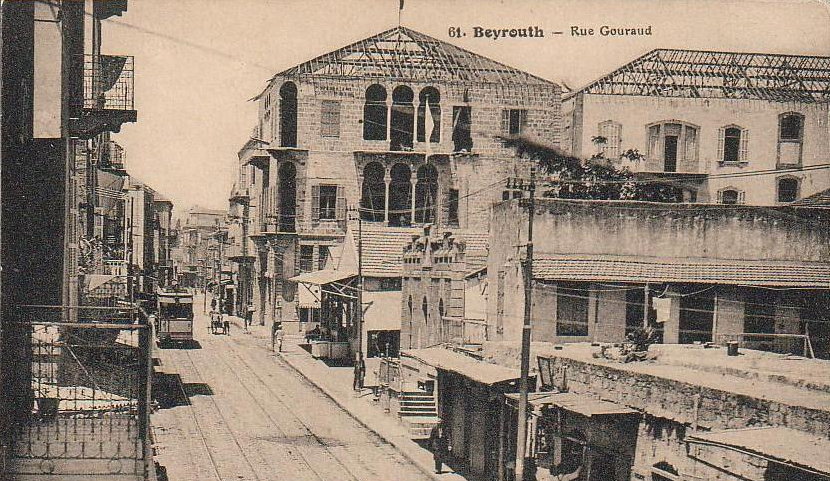
He drove down from Al Mina, and we could have spent the whole night going in circles around Al Maarad; I loved the modern buildings, so unblemished, and admired the vulgar geometric shapes, with splattered colors from the lights, in sharp contrast from the rest of the city, bathed in a shabby ochre that resembles a glowing gold sprayed with grey, with the colors and gestures of a dying oak. The radio blasted away with that song from the basement; I saw it announced once in a half-torn poster in Beirut, as I was heading with Eman toward Damascus Road. I daydreamed - even though it was night - that he would about-turn in Al Mina again and from there head down to Riad El Solh, to the very end, so that I could see the statue of Abdul Hamid Karami. I had seen it once in a postcard that a distant relative had sent in 1969. I also knew that the statue had been bombed with dynamite in 1976 but that still didn't quench my curiosity. The statue stood impassive at the center of a square of the same name, and the cars, like ballet figurines, tiptoed around it.
I had spent years leafing through the books at the library, trying to trace down the name of the artist, but to no avail. The novel of Bergsson, forgotten on page 115, under a stairway, came to me: "How could he have loved the woman if, in his mind, she is only a photograph? How can a picture be more real to the memory than the actual, living person?" I also knew that the name of the square had been changed, by the Tawhid, and that there was now a sculpture of the word "Allah". Perhaps Ismail had been right, it was God who had blown the statue at the square and replaced it with a sign. As I had all these thoughts in my mind, the old Peugeot drove into Bassel El Asad and Tripoli was being left behind. There had been no conversations since we left and the music kept blasting away; we spoke only with a timid smile that began in the corner of the mouth and rose through the pupils with a thick halo reflected at the height of the eye lids. It filled the entire space and as I gasped for air, the coastal highway opened its arms to us.
Al Qalamoun, it was, the old mosque. I preferred the churches, St. George, St. Catherine and the Monastery of St. John; at that point Tripoli was nowhere to be seen, and you could no longer hear its sounds, nor the riffle neither the fear. I was reminded then of St. Jerome's commentary on the Testament of John: "The blessed John the Evangelist, who remained in Ephesus to an advanced age and could scarcely be carried to church with the help of his disciples, could no longer put many coherent words together. At each assembly, he used to say no more than this: 'Little children, love one another!' Eventually, the disciples and brethren who were present grew tired of always hearing the same thing, and said: 'Master, why do you keep on saying this?' He replied with a sentiment worthy of John: 'Because it is a precept of the Lord, and it is sufficient if this alone is done." There was not a soul in the sight, until the prophet Isaiah spoke: "Against all the cedars of Lebanon, lofty and lifted up; and against all the oaks of Bashan."
Back at the theater in Tripoli, it was the year 1885, the first theater in the Middle East. The vendor woman, an old Alawite, told us that once they had rolled the red carpet all the way from the harbor to the theater for Oum Kalthoum to perform at the glorious Ottoman building. There was nothing but rubble to be seen now, and the sound of diggers and hammers. The Ingea Theater was no more. Now I recalled, it was Rabih Mroué who had asked Catherine Deneuve in that film, "You wanted to see, I also want to see but I can't seem to. Do you see that?" And the truth is that neither of us would see anything, but diggers, hammers and rubble. It wasn't only the theater, but the city and the whole country, there was nothing to see but rubble. At some point I wanted to ask him if maybe the whole world was made of rubble now. As we drove away, he told me: "You know, we, the Lebanese and the Jews, we are perhaps the first peoples to have advanced from the idea of nationalism." I nodded and woke up from the still quiet of the highway and heard at last the delicate voice.

"Do you see that?" He asked me. "The constellations on the sky stood steeply on their heads, all the stars had made an about-turn, but the moon, buried under the featherbed of clouds which were lit by its unseen presence, seemed still to have before her an endless journey and, absorbed in her complicated heavenly procedures, did not think of dawn." Does the sky look the same everywhere? I didn't ask that question, if only because my vague knowledge of science provided the answer. "Do you remember when I first saw you?" I asked him. And he was thinking the same thing I was thinking. "I shall never forget that luminous journey on that brightest of winter nights. The colored map of the heavens expanded into an immense dome, on which there loomed fantastic lands, oceans and seas, marked with the lines of stellar currents and eddies, with the brilliant steaks of heavenly geography." He didn't answer my question and insisted on driving into the village that suddenly carved itself out before the entrance of Batroun.

We couldn't get lost because in order to get lost, you have to know where you're getting lost from. At the entrance, we had to leave the car and our countenances too, in order to be transformed into aimless legs. We were not sad to let go of our possessions, for St. Augustine had taught: "Two things here on earth are essential: health and a friend. They are the two things most to be prayed for. Woe to the person who despises them. Health and friendship are natural gifts. God has made human beings for living -hence health, and for not living alone -hence the search for friendship." We took one of those cabbies that looked like tricycles in the miniature city and tried to make up our minds. "But who would entrust oneself on such a night to the whims of an unpredictable cabby? Amid the click of the axles, amid the thud of the box and the roof, I could not agree with him on my destination. He nodded indulgently at everything I said and sang to himself. We drove in a circle around the city."
"Is this you, George?" I exclaimed, and for the first time I recognized my friend.

[Passages taken from Bruno Schulz, "Cinnamon Shops", in "The Street of Crocodiles and Other Stories", Penguin, 2008]
"After Two Months", installation, Mouna Bassili Sehnaoui, 2010
After Two Months, installation, Mouna Bassili Sehnaoui, 2008